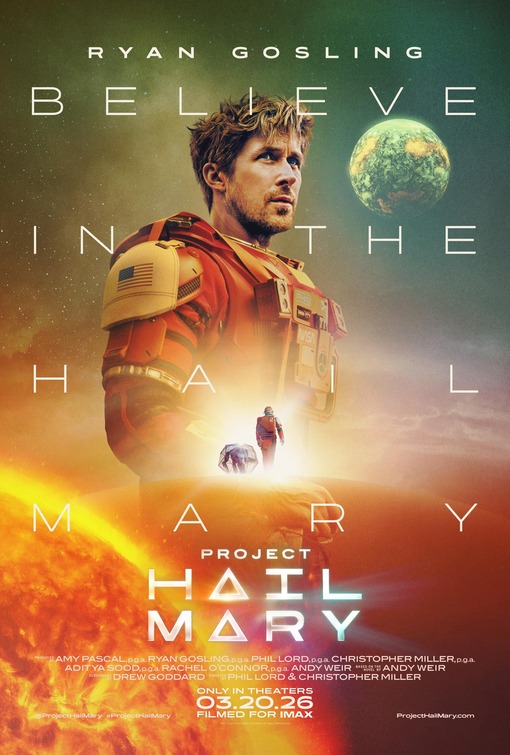
I've not read any of Andy Weir's books or stories, but it's interesting to note how similar the two big-screen adaptations of his work — The Martian and Project Hail Mary — feel, tone-wise. One was directed by Ridley Scott, who has a specific style (stylish, masculine), and the other is directed by Christopher Miller and Phil Lord, who are best known for goofy comedies and animated films. Or perhaps it's the voice of screenwriter Drew Goddard, who adapted both films, that comes through most clearly. In any case, both movies are about a single character, stranded, and (mostly) talking to themselves.
In this case, that character is Ryland Grace (Ryan Gosling), who awakens on board a spaceship with no memory of who he is, how he got there, or what he's supposed to be doing. He has two shipmates that are both unfortunately deceased. Eventually he pieces together his mission. Clusters of micro-organisms called "Astrophages" have appeared, forming a space trail from Venus to the Sun, and slowly sucking the energy away from the latter. In thirty years, the Sun will have dimmed enough that human life will be destroyed.
Similarly, the Astrophages have appeared all over the universe, except in one place. The star Tau Ceti has somehow remained immune. Grace is part of a mission to go there to find out why, with the hope that it can save our Sun. Unfortunately, it's a suicide mission, as there won't be fuel to return home. Instead, findings will be sent via probe. Fortunately, Grace is not alone. An alien life form has been sent on the same mission, hailing from another distant planet, Erid. The evolving relationship between Grace and the alien, whom he dubs "Rocky," is as important to the story as is the finding of the cure for the universe. Their attempts at communication, first through numbers, is charming and endlessly funny.
Indeed, Gosling puts a lot of work into this performance, performing dangerous space-walks, weightless slapstick bits, and simple yet spectacular wit and timing during his lonely line-reads. There are endless in-jokes about the amount of clutter he leaves lying around (more so during anti-gravity sequences), his array of funny t-shirts, and the various ways he hangs his glasses from his ears. Rocky is equally well-done, voiced (via a computer translator) by James Ortiz. Given the creature's rocky appearance, and the fact that he exists behind panes of glass (to protect its environment, which is hotter and contains more ammonia than a human can stand), makes it difficult to guess whether the effects are practical or CGI (though probably the latter).
Every so often we get a break from the emptiness of space to flashbacks chronicling the origin of the mission. Grace is a disgraced scientist (he suggested that not every life form should not necessarily need to have evolved from H20) now teaching high school science. A stoic government agent, Eva Stratt (Sandra Hüller), recruits him to work on the problem. He and Carl (Lionel Boyce), a security guard, discover that, not only are the Astrophages drawn to carbon dioxide (the atmosphere on Venus), but they're also multiplying.
There are more surprises in store, and this is a well-told story. The Martian irritated some viewers with its loose interpretation of science, but Project Hail Mary is more fictional, and hence more forgiving. Many viewers may wonder how Gosling keeps his ripped physique after so much time in space. I wondered why the ship's computer (whom Grace begins calling "Mary") is so monotone and one-note, when, in the age of AI, a ship's computer would certainly be more human-like (more Siri or Alexa), but if that were the case, then Grace wouldn't have such a need for the alien's company.
The other problem is that the movie is very long, and while it mostly moves, the flashbacks can sometimes feel a bit too much like padding. They help build Grace's character, yes, but they also provide every single possible detail and explanation for everything, which is not actually necessary. It also takes a good long while to actually end. (I checked my watch a couple of times.) Ultimately, the movie isn't about much more than those good old American staples, teamwork, friendship, and courage, which is perfectly fine. The truly memorable thing is simply spending time with Grace and Rocky, two fine and funny fellows.