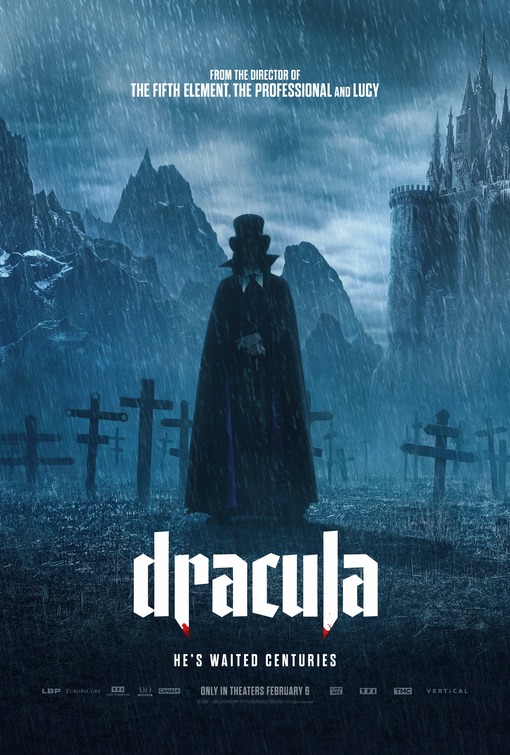
Stream it:
|
Own it:
|
With: Caleb Landry Jones, Christoph Waltz, Zoë Bleu, Matilda De Angelis, Ewens Abid, David Shields, Guillaume de Tonquédec, Bertrand-Xavier Corbi, Salomon Passariello, Haymon Maria Buttinger, Raphael Luce
|
Written by: Luc Besson, based on the novel by Bram Stoker
|
Directed by: Luc Besson
|
MPAA Rating: R for violence, some gore and sexuality
|
Running Time: 129
|
|
Date: 02/06/2026
|
|
|
|
Stake Charmer
By Jeffrey M. Anderson
Readers of this site know that I am partial to the films of Luc Besson. I think he's one of the unsung auteurs of his generation, a maker of shallow fluff, but with a signature style and a swiftness and lightness of touch that is positively joyful. His action and storytelling are crisp and rhythmic, and he has an eye for interesting and colorful visuals. (None of his films are exactly boring.) He's like a French Michael Mann, if you will.
But few agree with me, and taking that hand-in-hand with the enduring popularity of Dracula, there are going to be some, if not many, who take umbrage with Besson's new adaptation Dracula (formerly known as Dracula: A Love Tale). As for me, I was thrilled by it. If we break it down, there isn't a definitive cinematic adaptation of Bram Stoker. F.W. Murnau's Nosferatu is one of the best, but it was stolen, made without permission. Tod Browning's Dracula is great, but it was based on a play, and, admittedly, it can be slow and static. Terence Fisher's Horror of Dracula is very good. Love at First Bite and Dracula: Dead and Loving It are fun, but comedies.
John Badham's Dracula and Werner Herzog's Nosferatu are numbingly slow. Things like Van Helsing and Dracula Untold are abysmal. I enjoyed The Last Voyage of the Demeter, but it's only a fragment of the story. Francis Ford Coppola's Bram Stoker's Dracula is one that I've revisited more than once, and every time I see it, I'm struck by how beautiful is it, and how empty it is, how unmemorable the characters are (except for Gary Oldman's "butthead" Dracula). Finally Robert Eggers's Nosferatu was another one that rose closer to the top, but remained too grisly for me to be too eager to see it again.
Most of those movies are slow or stately or static, or otherwise grim and bleak. Besson's is the opposite. While that may seem the wrong approach for a Dracula movie — it's never been done! — there's no rules that says it's not allowed. It's a public domain source after all. Yet that's not to say that it's all fun and games. If we start with Caleb Landry Jones as Prince Vladimir of Wallachia, a.k.a. Dracula, we have a central role that is chilling, heartbreaking, debonair, and loathsome at the same time. He's reptilian, but he's an open book. Besson and Jones were lucky enough to find each other on their last film, the similarly underrated, misunderstood Dogman, and they were smart enough to stay in touch.
Vlad renounces God after the untimely death of his beloved wife Elisabeta (Zoë Bleu) and becomes a vampire. He pines for her over the centuries, desperately searching for her and awaiting her return. In 1889, Paris real estate man Jonathan Harker (Ewens Abid) arrives at his castle, and Dracula tells him his story of heartbreak and longing. But when Dracula sees a photo of Harker's fiancee Mina (Bleu), he realizes at last that his wife has returned. He imprisons Harker and goes to Paris. With the help of one of his minions, Maria (Matilda De Angelis), he tracks Mina down. But a Van Helsing-like priest (Christoph Waltz) is hot on Dracula's trail.
This Dracula is a bit long, but how it moves. In one scene, Dracula strides through a vulgar ballroom, filled with ladies in pink dresses and parasols as well as gentlemen gorging themselves and fornicating. He thinks he has found his Elisabeta but is cruelly rebuffed. In a flurry, he launches himself at several women and drinks from their necks. It's not scary, exactly, but we can't look away. Dracula's mixed pain and pleasure are enthralling. In another scene, a cackling, whirlwind Maria whips Mina through a fantastic, yet seedy, carnival as Dracula calmly looks on. (A mermaid at the carnival provides perhaps the movie's scariest moment.)
This movie has dancing, exploding cannonballs, and little stone gremlins that crawl and climb about, acting as Dracula's black-magical servants. Even they are not scary; they're actually kind of adorable. Which brings up another point. Should Dracula be scary? Is he still scary after all these years? Or is he merely fascinating? Besson, who has never really made a horror movie, went with fascinating, and focused on all the other emotions that are, and could be, part of the Dracula story. I'm not yet sure where I would rank it on my personal list of Dracula movies, but certainly closer to the top than to the bottom.
|