Every so often a documentary comes along that’s about more than just its thesis subject. Leviathan is about more than fishing. Brimstone and Glory is about more than fireworks. Even rarer are documentaries about humans that somehow transcend their subjects and tell stories about existence itself, films like Crumb, Exit Through the Gift Shop, and O.J.: Made in America. Nathan Fielder and Lance Oppenheim’s You Can See Everything is such a documentary. I believe it has earned a spot on my personal list of the great documentaries of the last one hundred years.
Ostensibly, the film is about Elizabeth Holmes, who purportedly invented a home health technology called Theranos that would have changed the world. She became a billionaire. Eventually, she was arrested for fraud, and the machine was said to have been a fake. Thirty-five days before she is to go to prison in Texas, she invites the comedian Nathan Fielder, known for his “trolling” videos, into her home to interview her and her partner, Billy Evans. Fielder’s co-director, Oppenheim, just released Primetime, a movie about a reality TV show.
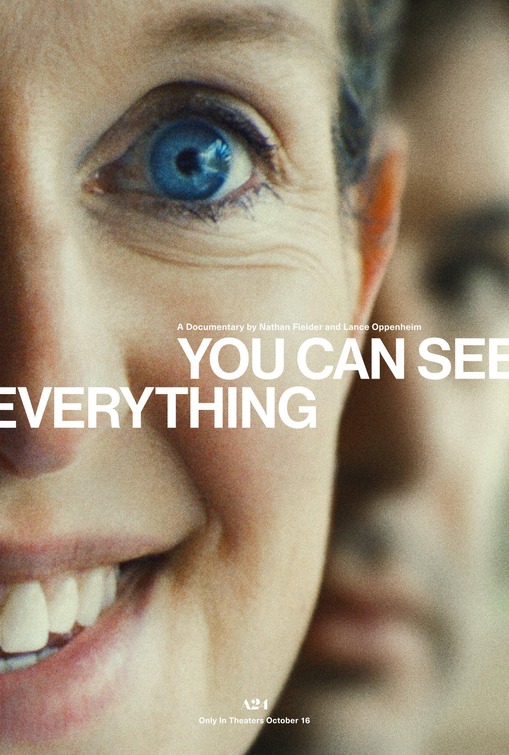
It’s such an odd setup. Right away Fielder and Oppenheim switch things up. The interviews are conducted in small spaces. Faces are filmed in extreme close-up. We notice that Holmes has very large, blue eyes that seem incapable of hiding anything. We can see every flicker of every expression of both interviewer and interviewee. It made me think of a film as great as Dreyer’s The Passion of Joan of Arc. The filmmakers allow for long pauses between questions and answers. The expansive running time of nearly three hours is absolutely necessary. This movie breathes. It pulses, tight and loose, tight and loose. It ponders.
Most interviewers, myself included, adopt a strategy of being friendly, kind, to try to put a subject at ease and get them talking. Fielder is more fearless. He doesn’t care how he comes off. He listens. He hears inconsistencies, and he jumps on them before they can get away. He interrupts. In one scene, that is far more powerful than it sounds, he argues with Holmes about the usage of the word “any.” She says that Theranos could “run any test.” Fielder contends that it would have been more correct to say that it was “capable” of running any test. Holmes doesn’t seem to understand the difference. It’s a strange and mysterious scene that lingers.
In trying to describe You Can See Everything, I find myself saying that it’s part mystery, part meta-documentary, and part existential exploration of the human soul. It has been suggested that journalists who are reviewing it not go into too much detail, and unlike spoiling, say, a superhero cameo in a summer blockbuster, I can say that this really matters. This is an experience for humans to savor. It’s a time out to consider the ups and downs of life, and how they’re all tied together. That, and more. If I had any other words to describe this unique and extraordinary film, I’d have a review that was just as unique and extraordinary. I’ll have to be content with falling short.