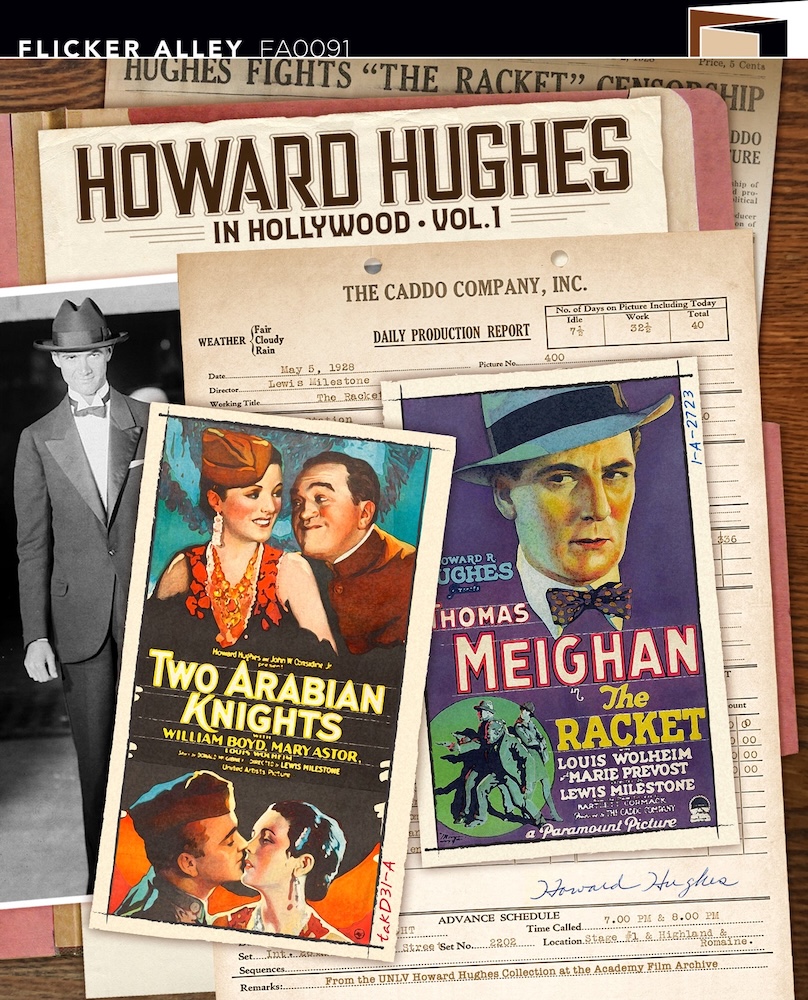
Howard Hughes began producing movies in Hollywood while in his early twenties, and immediately achieved success. Two Arabian Knights (1927) and The Racket (1928) are among his first surviving efforts, and while both are strangely not well known today, they are both still enormously entertaining.
Two Arabian Knights is a comedy about a soldier (William Boyd) and a sergeant (Louis Wolheim) who are captured, escape, and wind up on a ship to Arabia, where they rescue a princess (Mary Astor, later in The Maltese Falcon) from the ocean. Everybody falls in love with her, but there are many obstacles, including her father, an Emir. Boris Karloff apparently appears in a small role, but I didn't spot him. The film won the first and only Oscar for Best Comedy Direction, beating out Charlie Chaplin's The Circus!
The Racket is a serious crime film based around two solid characters, a cop, Captain James McQuigg (Thomas Meighan) and a prohibition-era gangster Nick Scarsi (Louis Wolheim), who have an interesting kind of relationship; Scarsi invites McQuigg to attend his kid brother's birthday party. But McQuigg also vows to catch Scarsi, and must contend with many complex plot turns (it was based on a play). The film's depiction not only of criminal activity, but of political and police corruption, gained it a notorious reputation at the time. Nevertheless, it was nominated for an Oscar for Best Picture (it lost to Wings).
Flicker Alley's released these two discoveries on an excellent two-disc Blu-ray set. Both have been restored to the best possible resolution, and although there are scratches and other damage apparent in some shots, the films are perfectly watchable. Bonuses for Two Arabian Knights include a commentary track by historian Harlow Robinson (author of a book on director Lewis Milestone), the new features "Howard Hughes in Hollywood" (17:33) and "Howard Hughes and the First Academy Awards" (8:33), and production stills, promotional materials, and production documents. The Racket includes a commentary track by film critics Glenn Kenny and Farran Smith Nehme, 44 minutes of outtakes (much of which was later re-used in Hughes's production of Scarface), and a remembrance of Hart Wegner, a founder of the UNLV film department (9:30). The set also includes a detailed, 28-page liner notes booklet. Recommended.